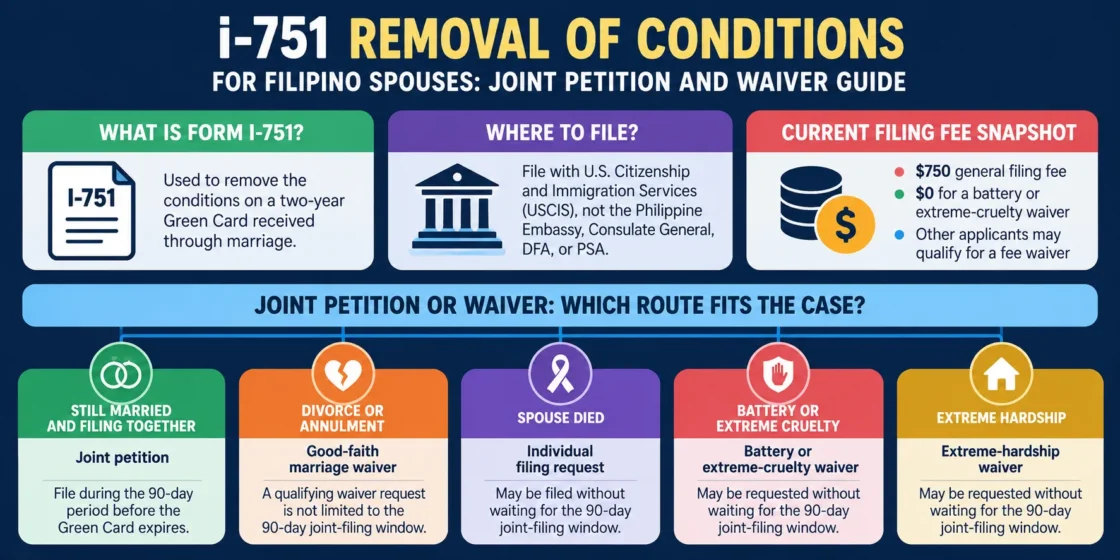
If a Filipino spouse received a two-year conditional Green Card through marriage, Form I-751 is the USCIS filing used to remove the conditions on residence. Filipino citizenship does not create a separate I-751 rule. The petition goes to U.S. Citizenship and Immigration Services (USCIS), not to the Philippine Embassy, a Philippine Consulate General, the DFA, or the PSA.
The first question is whether the case should be filed jointly with the petitioning spouse or under an individual filing or waiver basis. A joint I-751 normally must be filed during the 90-day period before the conditional Green Card expires. A qualifying waiver request does not have to wait for that 90-day window; USCIS states that an eligible waiver request may be made before a final order of exclusion, deportation, or removal.
Current filing snapshot: USCIS currently lists a $750 general filing fee for Form I-751. The current fee schedule lists a $0 fee for a conditional permanent resident filing a waiver of the joint-filing requirement based on battery or extreme cruelty. Certain other applicants may qualify for a fee waiver. The official Form I-751 page should be used for the current form edition, filing location, and payment instructions.
Joint Petition or Waiver: Which Route Fits the Case?
| Situation | Usual I-751 Route | Timing |
|---|---|---|
| Still legally married to the same U.S. citizen or lawful permanent resident spouse, and both spouses will file together | Joint petition | During the 90-day period before the conditional Green Card expires |
| Marriage was entered in good faith but later ended in divorce or annulment | Good-faith marriage waiver | A qualifying waiver request is not limited to the 90-day joint-filing window |
| U.S. citizen or lawful permanent resident spouse died | Individual filing request | USCIS allows the individual filing route without waiting for the 90-day joint-filing window |
| Conditional resident entered the marriage in good faith and was battered or subjected to extreme cruelty by the petitioning spouse | Battery or extreme-cruelty waiver | May be requested without waiting for the 90-day joint-filing window |
| Termination of conditional resident status and removal would cause extreme hardship | Extreme-hardship waiver | May be requested without waiting for the 90-day joint-filing window |
Separation by itself is not listed on Form I-751 as a separate waiver ground. If the couple is separated but still legally married, a joint filing may remain possible if both spouses continue to support it and every statement in the petition is accurate. If divorce is pending but not yet final, the good-faith divorce waiver normally depends on the marriage actually being terminated. Other waiver grounds may apply if their requirements are met.
How Joint I-751 Filing Works
A spouse who became a conditional permanent resident because the qualifying marriage was less than two years old when permanent residence began generally receives a Green Card valid for two years. Removing those conditions requires Form I-751; Form I-90 is not the form used to convert a two-year marriage-based card into a 10-year card.
For a joint filing, USCIS says the petition cannot be filed more than 90 days before the card expires. The expiration date on the conditional Green Card is therefore the practical date to use when calculating the filing window. USCIS provides the filing information through its official Form I-751 page.
Both the conditional resident and the petitioning spouse must take part in a joint petition. The current form requires the spouse’s signature when the filing basis is a joint petition with the spouse. Filing jointly does not mean that a couple must present a perfect marriage. USCIS is looking at whether the qualifying marriage was entered in good faith and whether the record supports the claimed marital relationship.
Evidence That Shows a Real Marital Life
USCIS evidence examples focus on the life the couple actually built together. A useful record often spans the marriage rather than showing only one recent month. Depending on the couple’s circumstances, evidence can include:
- leases, mortgages, deeds, or other records showing shared residence;
- joint bank, credit, loan, or other financial records showing shared assets or responsibilities;
- joint federal or state tax records;
- insurance records naming a spouse as an insured person or beneficiary;
- utility, household, or recurring account records tied to the shared home;
- birth certificates of children born to the marriage;
- other records that reflect an ongoing marital relationship; and
- affidavits from people with personal knowledge of the marriage.
Wedding photographs and a marriage certificate can help establish that a marriage took place, but an I-751 case usually turns on a broader period of shared life. Records that show residence, finances, family responsibilities, insurance, travel, major purchases, and other ordinary parts of the relationship can give USCIS a fuller record.
Core filing items: A properly completed Form I-751, copies of the front and back of the conditional Green Card for each conditional resident included where required, supporting evidence for the selected filing basis, the correct fee or an eligible fee-waiver request, and any additional documents required by the current USCIS instructions.
Good-Faith Divorce or Annulment Waiver
A Filipino conditional resident can request the joint-filing waiver when the qualifying marriage was entered in good faith but later ended through divorce or annulment. The former spouse does not need to sign the waiver filing.
The legal end of the marriage matters. USCIS guidance distinguishes a completed divorce or annulment from a marriage that is merely in divorce proceedings. If a jointly filed I-751 is already pending and the marriage later ends, USCIS may ask for the final divorce or annulment record and evidence that the marriage was genuine. USCIS may also allow the conditional resident to amend the filing basis from a joint petition to the good-faith divorce waiver.
Evidence should still address the history of the marriage, including the period before separation. A divorce decree proves that the marriage ended; it does not by itself prove that the marriage began in good faith. Shared-residence records, finances, insurance, taxes, children, correspondence, travel records, photographs, and other evidence from the relationship can remain relevant after divorce.
Pending divorce: A spouse should not mark the divorce or annulment waiver basis as though the marriage has already ended when the divorce is still pending. If the joint-filing deadline is approaching while a divorce remains unfinished, or if the other spouse will not sign, the filing strategy can affect lawful status and possible removal proceedings. Advice from an attorney licensed in the United States or an accredited representative working for a DOJ-recognized organization can be appropriate in that situation.
Battery or Extreme-Cruelty Waiver
A conditional resident who entered the qualifying marriage in good faith may request a waiver if the U.S. citizen or lawful permanent resident spouse battered the conditional resident or subjected the conditional resident to extreme cruelty during the marriage. The current USCIS filing basis does not require the abusive spouse’s signature.
USCIS also states that a battery or extreme-cruelty waiver may be requested while the person is still married, separated, divorced, or residing with the petitioning spouse. The filing does not depend on first obtaining a divorce.
Evidence depends on the facts. A personal statement, medical or counseling records, court records, police records, protective orders, communications, photographs, affidavits from people with personal knowledge, and other relevant records may be used when they exist. A case should reflect what actually happened; a person should not create or alter evidence to fit a filing category.
USCIS uses special confidentiality procedures for certain protected cases, including I-751 filings based on battery or extreme cruelty. Address changes for an I-751 abuse waiver also follow special procedures rather than the ordinary address-change route. The USCIS change-of-address information explains the protected-case process.
Extreme-Hardship Waiver
Form I-751 also provides a waiver basis when termination of conditional resident status and removal from the United States would result in extreme hardship. This is a separate legal basis from the good-faith divorce and battery or extreme-cruelty waivers.
Ordinary inconvenience, the cost of relocation, or a preference to remain in the United States should not automatically be treated as enough. Extreme-hardship cases are fact dependent, and the evidence must match the legal basis being claimed. Medical, family, financial, country-condition, caregiving, educational, or other records may be relevant depending on the facts.
Because the legal standard and the time period USCIS may consider can affect the outcome, an extreme-hardship waiver is one of the situations where case-specific legal advice can be especially useful.
If the Petitioning Spouse Dies
If the qualifying marriage was entered in good faith and the petitioning spouse dies, USCIS allows the conditional resident to pursue removal of conditions through an individual filing request. The surviving spouse should provide the required evidence of the spouse’s death together with evidence addressing the good-faith marriage.
If a jointly filed I-751 is already pending when the petitioning spouse dies, USCIS states that the filing can be amended to the individual filing basis. A foreign death certificate that is not in English must be accompanied by the required English translation.
Filipino Documents and English Translations
Documents issued in the Philippines can be part of an I-751 record when they are relevant. A PSA marriage certificate, for example, may document the marriage itself, while other Philippine records may help explain family, property, travel, or civil-status facts. They do not replace the need to show the marital relationship during conditional residence when that evidence is required.
USCIS rules require a full English translation for a document containing a foreign language. The translator must certify that the translation is complete and accurate and that the translator is competent to translate from the foreign language into English. Many Philippine civil documents contain English, but any material foreign-language content submitted to USCIS should be handled under the translation rule.
Filing Fee, Form Edition, and Where to Send the Package
The current USCIS Fee Schedule lists the general Form I-751 filing fee as $750. It lists a $0 filing fee for a conditional permanent resident, spouse, or child filing a waiver of the joint-filing requirement based on battery or extreme cruelty. The same fee schedule states that certain applicants may qualify for a fee waiver. USCIS provides fee-waiver instructions on the Form I-912 page.
Older I-751 instructions and older immigration pages may show a separate biometric services fee. The current USCIS Fee Schedule should control the amount sent with a new filing. Sending an outdated fee can cause a filing problem.
The current Form I-751 PDF available from USCIS carries edition date 04/01/24. Filing addresses can change, so the package should be mailed to the address USCIS currently assigns on the Form I-751 filing page rather than to an address copied from an old checklist, forum post, or prior filing.
What Happens After USCIS Accepts the I-751?
USCIS issues a receipt notice after accepting a properly filed petition. For I-751 petitioners, USCIS currently extends the validity of the conditional Green Card for 48 months beyond the card’s expiration date. The expired Green Card and the Form I-797 receipt notice should be kept together as evidence of continued conditional permanent resident status during that extension period.
USCIS may require biometrics, request more evidence, or schedule an interview. An interview is not automatic in every case; USCIS has authority to waive an I-751 interview when the record and eligibility support doing so. If USCIS schedules an interview, the conditional resident must follow the appointment notice.
Processing time is not a fixed number for every I-751. USCIS publishes current case-processing information through its processing-times tool. The receipt number and later transfer notices can also help identify how USCIS is handling the case.
Work and International Travel While the I-751 Is Pending
A pending I-751 does not turn a conditional permanent resident into a temporary nonimmigrant. The person remains a conditional permanent resident while the properly filed petition is pending. The expired conditional Green Card together with the applicable I-797 extension notice serves as evidence of continued status during the extension period.
For international travel, the traveler should carry the documents USCIS identifies as proof of status and also consider the separate rules that apply to long trips outside the United States. Airline document checks and U.S. admission procedures are separate from I-751 adjudication. A person who needs temporary proof of permanent resident status beyond available documentary evidence can contact USCIS about temporary evidence of status.
Late Joint Filing
Missing the 90-day joint-filing window should not be ignored. USCIS may accept a late joint I-751 when the conditional resident establishes good cause and extenuating circumstances for the late filing. The filing should include an explanation of the delay and supporting evidence when available.
Failure to file can lead USCIS to terminate conditional resident status and begin removal proceedings. Late filing therefore calls for prompt action rather than waiting for another Green Card renewal window.
Can Form N-400 Be Filed While I-751 Is Pending?
In some cases, yes. A conditional resident who otherwise qualifies for naturalization may be able to file Form N-400 while Form I-751 remains pending. USCIS states that it will adjudicate the I-751 before or concurrently with the N-400.
The three-year naturalization route is not available merely because someone once received residence through marriage. It generally requires eligibility under the rules for spouses of U.S. citizens, including the applicable marriage, marital-union, residence, physical-presence, and other naturalization requirements. A person married to a lawful permanent resident rather than a U.S. citizen does not qualify for the three-year spouse-of-a-U.S.-citizen rule on that basis.
Errors That Commonly Create I-751 Problems
- Using Form I-90 instead of Form I-751 to remove marriage-based conditions.
- Filing a joint petition too early, before the 90-day filing period begins.
- Claiming a divorce waiver before the divorce or annulment is final when no other waiver basis applies.
- Submitting only wedding-era evidence while leaving the period of conditional residence largely undocumented.
- Using an old filing fee or old mailing address rather than the current USCIS instructions.
- Failing to report a move to USCIS, which can cause notices to go to an old address.
- Leaving a pending joint petition unchanged after a divorce becomes final instead of informing USCIS of the changed circumstance.
- Submitting foreign-language records without the required English translation and translator certification.
Requirements, fees, form editions, filing addresses, and USCIS procedures can change. The current instructions from USCIS should be used when preparing and sending the petition, especially when a filing involves divorce, abuse, removal proceedings, a missed deadline, or another fact that changes the ordinary joint-filing route.
Sources
- U.S. Citizenship and Immigration Services — Form I-751, Petition to Remove Conditions on Residence. Official form page for current form downloads, filing instructions, fees, and filing location information.
- U.S. Citizenship and Immigration Services — Form I-751 PDF. Official form showing the current filing-basis selections and form edition.
- U.S. Citizenship and Immigration Services — Family-Based Conditional Permanent Resident Joint Filing. Official USCIS fact sheet covering joint filing, the 90-day filing period, and related I-751 issues.
- U.S. Citizenship and Immigration Services — Family-Based Conditional Permanent Resident Individual and Waiver Filing Requests. Official USCIS fact sheet covering divorce, death, battery or extreme cruelty, extreme hardship, and changes in filing basis.
- U.S. Citizenship and Immigration Services — Form G-1055, Fee Schedule. Official USCIS fee schedule for current I-751 filing fees and fee-waiver information.
- U.S. Citizenship and Immigration Services — Response to the Citizenship and Immigration Services Ombudsman Annual Report. Official USCIS report documenting the 48-month Green Card validity extension for properly filed Form I-751 petitions.
- U.S. Citizenship and Immigration Services — Interview Waiver Criteria for Family-Based Conditional Permanent Residents. Official USCIS policy guidance on when an I-751 interview may be waived.
- Electronic Code of Federal Regulations — 8 CFR 103.2. Official federal regulation containing the English-translation requirement for foreign-language documents submitted to USCIS.
- U.S. Citizenship and Immigration Services — Case Processing Times. Official tool for current USCIS processing-time information.