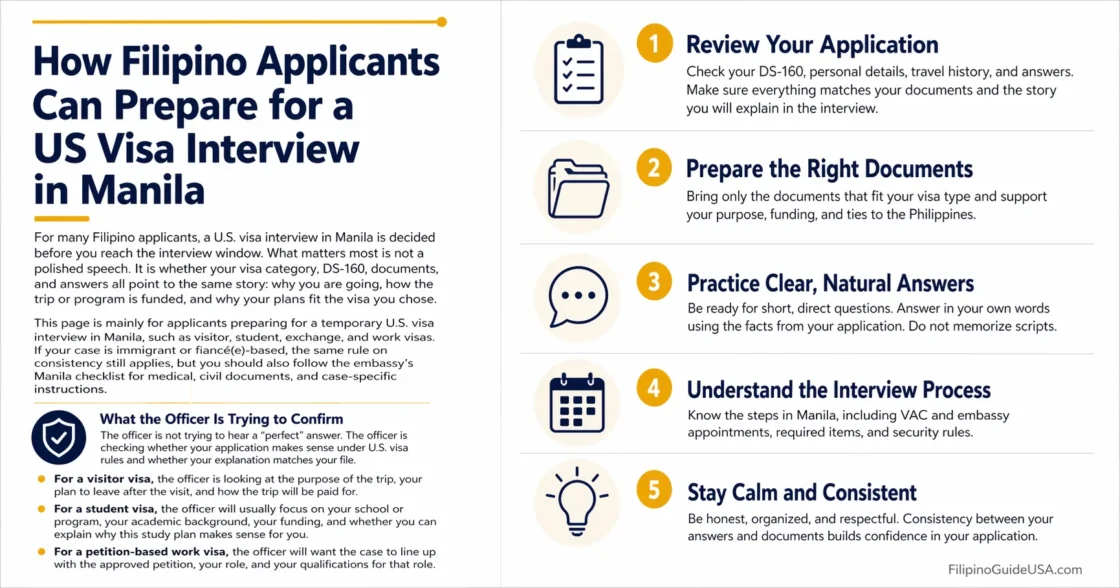
For many Filipino applicants, a U.S. visa interview in Manila is decided before you reach the interview window. What matters most is not a polished speech. It is whether your visa category, DS-160, documents, and answers all point to the same story: why you are going, how the trip or program is funded, and why your plans fit the visa you chose.
This page is mainly for applicants preparing for a temporary U.S. visa interview in Manila, such as visitor, student, exchange, and work visas. If your case is immigrant or fiancé(e)-based, the same rule on consistency still applies, but you should also follow the embassy’s Manila checklist for medical, civil documents, and case-specific instructions.
What the Officer Is Trying to Confirm
The officer is not trying to hear a “perfect” answer. The officer is checking whether your application makes sense under U.S. visa rules and whether your explanation matches your file.
For a visitor visa, the officer is looking at the purpose of the trip, your plan to leave after the visit, and how the trip will be paid for.[c]
For a student visa, the officer will usually focus on your school or program, your academic background, your funding, and whether you can explain why this study plan makes sense for you.[d]
For a petition-based work visa, the officer will want the case to line up with the approved petition, your role, and your qualifications for that role.[e]
A thick folder does not fix a weak match between your visa class and your real plan. If you are still unsure whether your trip belongs under a visitor, student, exchange, or work category, sort that out first. Interview practice only helps after the visa class is correct.
What to Review Before You Leave Home
Start with your DS-160. Many avoidable interview problems come from small mismatches that look minor to the applicant but stand out to the officer.
Check your name, passport number, date of birth, and contact details exactly as they should appear.
Review your current job, school, income, travel history, and U.S. contact details so your spoken answers do not drift away from what you submitted.
Be ready to explain who is paying, how much the trip or program will cost, and why the timing of the trip makes sense.
Have the information used to complete your DS-160 close at hand. The State Department says applicants may need passport details, prior U.S. travel dates, work and education history, and category-specific information such as a SEVIS ID for students or petition details for certain workers.[a]
For Manila scheduling, do not think only about the interview window. Under the embassy’s current appointment process, many applicants handle two separate appointments: one at the Visa Application Center for photos and fingerprints, and another at the embassy for the interview itself.[g] Print the confirmations you need and keep them in the front of your folder.
If you still need to pay the application fee, check your visa class carefully before paying. The State Department’s current fee page lists the non-petition-based nonimmigrant visa application fee at $185 for many common categories, including B, F, and J visas, while some petition-based work categories use a different fee tier.[f]
What to Put in Your Folder
Keep your documents simple and ordered. A clean folder is easier to use than a thick stack of mixed papers.
Your current passport. For most nonimmigrant cases, it should be valid for at least six months beyond your intended U.S. stay.[d]
Your DS-160 confirmation page.[a]
Your fee receipt, if your visa class requires payment before the interview.[f]
Your printed appointment confirmation for the VAC and the embassy, if your case includes both steps.[g]
A printed visa photo only if the DS-160 photo upload failed. If the confirmation page shows your photo, a separate printed photo is not normally needed for that reason.[b]
Bring Only the Supporting Papers That Fit Your Visa Type
For B1/B2 visitor cases, think in three groups: your reason for travel, your ability to pay, and your reasons to return after the trip. The State Department notes that officers may look for proof of the trip’s purpose, proof you will leave after the visit, and proof of how costs will be covered. It also says employment and family ties may help, while an invitation letter or Affidavit of Support is not required for a visitor visa and is not the basis for the decision by itself.[c]
Employer letter, approved leave, or business records if they clearly explain what you do
Bank records or other funding proof that match what you claim in the interview
A simple itinerary or event purpose if the trip is for business, family, tourism, or medical consultation
Documents that show why you return after the trip, such as work, studies, family, or ongoing business responsibilities
For F, M, and J cases, bring the school or program document that belongs to your category and be ready to talk through your plan in plain language. State’s student visa instructions point to the I-20, academic records, and proof of how you will cover education, living, and travel costs.[d]
Form I-20 or DS-2019, depending on the visa class
Admission or program papers that match the DS-160
Transcripts, diploma, degree, or test results if they help explain your academic path
Clear proof of funding from you, your family, or your sponsor
A short, natural explanation of why you chose that school, course, or exchange program
For petition-based work visas, your folder should help you explain the job without sounding as if you memorized a script. The State Department’s temporary worker page says applicants should have the petition receipt number or related approval notice details available, and it also reminds applicants that petition approval does not guarantee visa issuance.[e]
Your petition receipt or approval details
An employer letter or job summary that matches the petition
Degree, license, CV, or work records that help explain why you fit the role
A plain-English explanation of what you will actually do in the United States
If you are applying for F, M, J, H-1B, or H-4, check the latest State Department instruction on online presence review. As of December 15, 2025, those applicants are instructed to set all social media profiles to public for vetting purposes.[j]
How to Practice Without Sounding Rehearsed
The best interview practice is not memorizing long answers. It is learning how to answer short questions clearly, in your own words, without drifting away from your application.
Answer the question asked first. Add more only if the officer asks for more.
Use the same facts that appear on your DS-160, but say them naturally.
Do not guess about dates, salaries, school details, or employer details. If you are unsure, say so and correct yourself carefully.
Do not bring in extra stories that create new problems, especially about work, long stays, or vague travel plans.
Keep your explanation simple enough that it sounds like your real life, not a rehearsed paragraph.
Questions You Should Be Able to Answer Naturally
For visitor visas: Why are you going, how long will you stay, who is paying, what do you do in the Philippines, and what brings you back after the visit?
For student visas: Why this school, why this course, how will you pay, what have you studied before, and what is your plan after the program?
For work visas: Who is the employer, what is your job title, what work will you do, where will you work, and how does your background fit the petition?
If your case has a weak spot, do not try to hide it with too many papers. A better approach is to state the facts cleanly and show the document that actually supports that fact.
What to Expect at the Embassy in Manila
Interview day in Manila usually moves faster for applicants whose papers are already in order. Keep your documents in a simple sequence so you are not searching through a large envelope while answering questions.
Bring only what you need for your appointment.
Do not bring your phone or other electronics. The embassy states that cell phones and other electronic devices are not allowed inside, and it does not hold items for applicants.[h]
Have your passport, DS-160 confirmation, appointment printouts, and category-specific documents ready at the top of your folder.
If your case included a VAC step, your photo and fingerprints may already have been handled there, so follow the appointment path shown in your account and confirmations.[g]
Expect a short interview. Many cases are decided through a small number of direct questions.
After the interview, the case may be issued, refused, or placed into administrative processing. The State Department also notes that interview wait-time estimates are only estimates and do not include any extra time needed for administrative processing.[i]
That is why it is better not to book non-refundable travel just because you secured an interview date. An interview slot is not the same thing as visa issuance.[c]
Questions Many Applicants Ask
Do I Need an Invitation Letter for a Visitor Visa?
Not as a standard requirement. For B1/B2 cases, State says a letter of invitation or Affidavit of Support is not needed to apply, and it is not one of the deciding factors by itself. If you bring one, it should support a real trip purpose, not replace proof of your own ties and funding.[c]
Should I Bring a Printed Photo Even if I Uploaded One Online?
Bring one only if the online photo upload failed or if your appointment instructions tell you to do so. The State Department says that when the DS-160 confirmation page already includes your photo, the upload was successful.[b]
Should I Buy a Ticket Once I Have an Interview Date?
No. A scheduled interview does not mean the visa is approved, and official visa pages warn applicants not to make final travel plans or buy tickets until they actually have the visa.[c]
What if My Case Is Immigrant or Fiancé(e)-Based Instead?
Use the Manila embassy’s case-specific checklist for that visa class. Those cases can involve a medical exam, civil documents, and timing rules that are different from a standard nonimmigrant interview. The advice on consistency, document order, and natural answers still helps, but it does not replace the post-specific checklist for your category.
Visa rules, fee amounts, interview-waiver policies, appointment steps, and embassy procedures can change. Before you pay, upload, reschedule, or travel, recheck the current Department of State and U.S. Embassy in the Philippines pages for your exact visa class.
Sources
DS-160: Frequently Asked Questions — Used for the section on reviewing the DS-160 and the information applicants may need while completing it. (Reliable because it is the U.S. Department of State’s official DS-160 information page.)
Photo Frequently Asked Questions — Used for the note on when a printed photo is needed after DS-160 photo upload. (Reliable because it is the State Department’s official visa-photo guidance.)
Visitor Visa — Used for the visitor-visa section on trip purpose, funding, return ties, invitation letters, and the reminder not to buy tickets before visa issuance. (Reliable because it is the State Department’s official B visitor visa page.)
Student Visa — Used for the student section on required documents, funding, passport validity, and interview preparation. (Reliable because it is the State Department’s official student visa page.)
Temporary Worker Visas — Used for the work-visa section on petition-linked documents, interview preparation, and the point that petition approval does not by itself guarantee a visa. (Reliable because it is the State Department’s official temporary worker visa page.)
Fees for Visa Services — Used for the current nonimmigrant visa fee information. (Reliable because it is the State Department’s official visa-fee schedule.)
FAQs: The New Visa Appointment System and Process — Used for the Manila scheduling section on separate VAC and embassy appointments. (Reliable because it is an official U.S. Embassy in the Philippines visa-information page.)
U.S. Embassy Manila, Philippines – MNL — Used for the embassy-day note on security rules and the ban on cell phones and other electronics inside the embassy. (Reliable because it is the State Department’s official Manila post page.)
Visa Appointment Wait Times — Used for the section on changing interview availability and the fact that administrative processing is not included in appointment-wait estimates. (Reliable because it is the State Department’s official visa wait-time resource.)
Announcement of Expanded Screening and Vetting for H-1B and Dependent H-4 Visa Applicants — Used for the current note on public social media settings for F, M, J, H-1B, and H-4 applicants. (Reliable because it is an official State Department visa-policy announcement.)