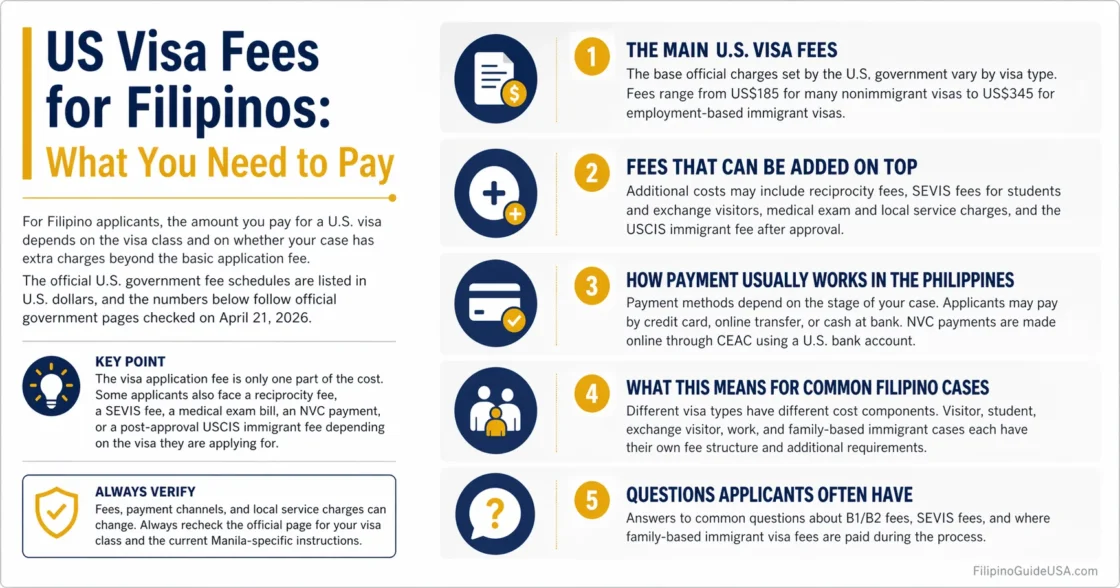
For Filipino applicants, the amount you pay for a U.S. visa depends on the visa class and on whether your case has extra charges beyond the basic application fee. The official U.S. government fee schedules are listed in U.S. dollars, and the numbers below follow official government pages checked on April 21, 2026.[a]
What many short articles miss is that the visa application fee is only one part of the cost. Some applicants also face a reciprocity fee, a SEVIS fee, a medical exam bill, an NVC payment, or a post-approval USCIS immigrant fee depending on the visa they are applying for.[f]
The Main U.S. Visa Fees
These are the base official charges most Filipino applicants look at first.[a]
| Visa Type | Official Fee | What It Usually Covers |
|---|---|---|
| B1/B2, C-1/D, F, J, M, and other non-petition nonimmigrant categories | US$185 | Standard nonimmigrant visa application fee |
| H, L, O, P, Q, and R | US$205 | Petition-based work and related nonimmigrant categories |
| E | US$315 | Treaty trader or treaty investor visa categories |
| K | US$265 | Fiancé(e) or spouse of a U.S. citizen |
| Family-Based Immigrant Visa | US$325 | Most immediate relative and family preference immigrant visa cases |
| Employment-Based Immigrant Visa | US$345 | Approved employment immigrant petition cases |
| Other Immigrant Categories | US$205 | Includes returning resident and some special immigrant cases |
| Diversity Visa | US$330 | Per person for selected DV applicants |
| Affidavit of Support Review | US$120 | Separate NVC-stage fee in cases where it applies |
Fees That Can Be Added on Top
Reciprocity Fee
The reciprocity fee is not the same as the visa application fee. It is an added issuance fee that applies only when the visa category and nationality call for it.[a]
For Philippine passport holders, the current State Department reciprocity table shows that many common categories have no added reciprocity fee, while some work and treaty categories do.[b]
| Category for Philippine Passport Holders | Reciprocity Fee | Entries | Validity Listed by State Department |
|---|---|---|---|
| B-1 / B-2 / B-1/B-2 | None | Multiple | 120 months |
| F-1 | None | Multiple | 60 months |
| J-1 | None | Multiple | 60 months |
| K-1 | None | One | 6 months |
| H-1B / H-4 | US$459 | Multiple | 60 months |
| L-1 / L-2 | US$459 | Multiple | 36 months |
| R-1 / R-2 | US$348 | Multiple | 60 months |
| E-1 | US$703 | Multiple | 60 months |
| E-2 | US$552 | Multiple | 60 months |
This matters because many third-party pages blur together the basic visa fee and the reciprocity fee. For example, a Filipino applying for a B1/B2 visitor visa still pays the standard US$185 application fee, but the current reciprocity table does not add a separate issuance fee for B-1, B-2, or B-1/B-2 visas.[b]
SEVIS Fee for Students and Exchange Visitors
For F-1 and M-1 students, the visa fee is not the full cost. The I-901 SEVIS fee is generally US$350, and some J-1 exchange visitor categories pay US$220 or a lower reduced amount under the official SEVIS rules.[c]
On the visa side, applicants in official U.S. government-sponsored J programs are exempt from the visa application fee itself.[a]
Medical Exam and Local Service Charges
For immigrant visa processing in Manila, the Embassy states that medical examination charges, including x-ray and blood test fees, are paid directly to St. Luke’s Extension Clinic rather than included in the visa fee.[f]
If you choose 2GO Express premium pick-up or drop-off, the Embassy announced a fee of Php 630 per visa applicant effective February 1, 2026.[h]
USCIS Immigrant Fee After Approval
Most people who receive an immigrant visa overseas must also pay the USCIS Immigrant Fee before traveling to the United States. USCIS lists that fee at US$235.[e]
This post-approval fee does not apply to K visa holders, returning residents, or certain adoption-based cases listed by the U.S. government.[f]
How Payment Usually Works in the Philippines
For the Philippine nonimmigrant visa appointment system, official Embassy guidance says applicants may pay the visa fee by credit card, online transfer, or cash at bank.[g]
For immigrant visa fees collected at the Embassy rather than through NVC, the Manila instructions say the consular cashier accepts cash and credit cards in U.S. dollars or the Philippine peso equivalent, and that the application fee is non-refundable.[f]
For cases handled by the National Visa Center, payment works differently. NVC says fees must be paid through CEAC, in U.S. dollars, using funds drawn on a U.S. bank account rather than by mail or credit card.[d]
What This Means for Common Filipino Cases
Visitor Visa: Most B1/B2 applicants start with the US$185 application fee. The current Philippines reciprocity table does not add a B1/B2 issuance fee for Philippine passport holders.[b]
Student Visa: An F-1 applicant usually pays the US$185 visa fee and then the separate I-901 SEVIS fee. The reciprocity table currently shows no added reciprocity fee for F-1 visas issued to Philippine passport holders.[c]
Exchange Visitor Visa: A J-1 applicant often pays both the visa fee and the SEVIS fee, but the exact SEVIS amount depends on the program type. Some official U.S. government-sponsored J programs do not pay the visa application fee.[a]
Work Visa: H and L applicants pay the petition-based visa application fee, and many Filipino applicants in these categories also face a reciprocity fee under the Philippines reciprocity table.[b]
Family-Based Immigrant Visa: Many applicants pay the immigrant visa processing fee, may also face the Affidavit of Support review fee during NVC processing, must handle the medical exam separately, and then pay the USCIS immigrant fee after visa issuance.[d]
Questions Applicants Often Have
Is The B1/B2 Tourist Visa Fee Different for Filipinos?
No. Filipino applicants pay the same standard nonimmigrant application fee listed by the U.S. State Department for B visas, and the Philippines reciprocity table currently shows no added issuance fee for B-1, B-2, or B-1/B-2 visas.[a]
Is The SEVIS Fee Included in the Visa Fee?
No. The I-901 SEVIS fee is separate from the visa application fee, so students and many exchange visitors should budget for both payments.[c]
Do Family-Based Immigrant Visa Applicants Pay Everything at the Embassy?
Not always. Many family-based immigrant visa fees are paid during the NVC stage through CEAC, and some applicants later pay the USCIS immigrant fee after visa issuance and before travel.[d]
Fees, payment channels, and local service charges can change. Before you pay, recheck the official page for your visa class and the current Manila-specific instructions if your case is being handled in the Philippines.[f]
Sources
- U.S. Department of State — Fees for Visa Services (Used for the official nonimmigrant and immigrant visa fee amounts listed in the fee tables and examples above; reliable because it is the State Department’s primary visa fee page.)
- U.S. Department of State — Visa Reciprocity and Civil Documents by Country: Philippines (Used for reciprocity fee amounts, entry count, and validity periods for Philippine passport holders; reliable because it is the official country-specific reciprocity record maintained by the State Department.)
- U.S. Immigration and Customs Enforcement — I-901 SEVIS Fee Frequently Asked Questions (Used for SEVIS fee amounts for F, M, and J applicants; reliable because it is the DHS/ICE page for the SEVIS fee system.)
- U.S. Department of State — Pay Fees: The Immigrant Visa Process (Used for NVC payment flow, CEAC payment instructions, and related immigrant-visa-stage fee handling; reliable because it is the State Department’s official immigrant visa process page.)
- U.S. Citizenship and Immigration Services — USCIS Immigrant Fee (Used for the post-approval USCIS immigrant fee amount; reliable because it is the official USCIS fee page for lawful permanent resident visa packet processing and green card production.)
- U.S. Department of State — U.S. Embassy Manila, Philippines (MNL) Visa Supplement (Used for Manila-specific payment instructions, non-refundable fee language, medical exam handling, and USCIS immigrant fee exemptions noted after approval; reliable because it is the State Department’s post-specific instruction page for Manila.)
- U.S. Embassy in the Philippines — FAQs on the New Visa Appointment System and Process (Used for current payment method options in the Philippine appointment system; reliable because it is the official Embassy FAQ for local visa appointment handling.)
- U.S. Embassy in the Philippines — Changes in 2GO Express Premium Service Fee (Used for the local premium pick-up and drop-off charge in the Philippines; reliable because it is the Embassy’s own service update page.)